
What is a Chemistry Session?
A Chemistry Meeting is an opportunity to chat with your potential coach to get to know more about them and how they might work with you to achieve your career goals.
A Chemistry Meeting is indeed a crucial step in the process of selecting a coach. Let's expand on this concept and explore what to look for, a typical agenda, and how to compare different meetings:
Purpose of a Chemistry Meeting: A Chemistry Meeting allows you to assess the potential fit between you and the coach. It's an opportunity to gauge their approach, expertise, and personality to determine if they're the right person to help you achieve your goals.
Why Chemistry Meetings Are Standard Practice in Professional Coaching
Chemistry meetings have become standard practice across professional coaching engagements because the effectiveness of coaching depends heavily on the quality of the working relationship between coach and client. Unlike consulting or training, coaching relies on open reflection, honest conversation, and a willingness to challenge existing thinking. Establishing a level of trust and comfort early in the process is therefore essential.
In executive coaching and leadership development programs, organisations often require chemistry sessions before beginning a coaching engagement. This helps ensure that leaders feel confident in the coach’s approach and that both parties believe the partnership will be productive. Taking the time to establish this alignment
significantly increases the likelihood of meaningful development and sustained behavioural change.
How Coaches Use Chemistry Meetings
Chemistry meetings are not only an opportunity for clients to evaluate coaches. Coaches are also using the session to assess whether they are the right person to support your development.
Experienced coaches will be listening carefully to understand the nature of the challenges you are facing, the organisational context you operate in, and your readiness for coaching. In some cases, they may determine that another coach with different expertise would be a better match.
Professional coaches are also mindful of maintaining appropriate boundaries. If the goals discussed fall outside the scope of coaching—for example, if someone is seeking therapy or specialised consulting advice—a responsible coach will suggest alternative support. This mutual assessment helps ensure that any coaching engagement begins with clear expectations and a strong professional foundation.
How to Prepare for a Chemistry Meeting
Although chemistry meetings are informal conversations, spending a little time preparing can make the discussion far more valuable. The clearer you are about your objectives and expectations, the easier it will be to determine whether a coach is the right partner for your development.
Before the meeting, consider reflecting on a few key questions. What prompted you to explore coaching at this point in your career? Are you navigating a leadership transition, seeking greater clarity about your professional direction, or looking to
strengthen particular leadership capabilities? Having examples of current challenges or goals can help the coach understand your situation more quickly.
It is also useful to think about what success would look like from your perspective. Coaching engagements often run over several months, so having a sense of the outcomes you hope to achieve will help guide the discussion and allow the coach to explain how they might support that journey.
What to look for during a Chemistry Meeting:
- Rapport: Do you feel comfortable talking to the coach? Is there a natural flow in conversation?
- Listening skills: Does the coach actively listen and ask insightful questions?
- Understanding: Can the coach grasp your situation and goals quickly?
- Expertise: Does the coach demonstrate knowledge relevant to your needs?
- Approach: Does their coaching style align with your preferences and learning style?
- Professionalism: Do they present themselves in a manner that instills confidence?
- Clarity: Can they explain their process and expected outcomes clearly?
Typical agenda for a Chemistry Meeting
While the structure of a Chemistry Meeting may vary depending on the coach and your specific circumstances, a well-organized session generally follows a framework that covers key areas essential for both parties to assess compatibility and potential value.
- Introduction and background of both parties
- Discussion of your current situation and career goals
- Exploration of potential areas for coaching
- Coach's explanation of their approach and methodologies
- Overview of the coach's experience and qualifications
- Q&A session for you to ask about their process, fees, availability, etc.
- Discussion of next steps if you decide to proceed
How to compare different Chemistry Meetings
After engaging in multiple Chemistry Meetings with potential coaches, it's essential to systematically evaluate and compare your experiences to make an informed decision about which coach will best serve your needs and goals.
- Create a scorecard: Develop a list of criteria important to you (e.g., expertise, communication style, availability) and rate each coach on these factors.
- Reflect on your comfort level: Consider with which coach you felt most at ease and open.
- Review notes: Compare the insights and suggestions each coach provided during the meeting.
- Assess alignment: Determine which coach's approach and style best aligns with your goals and preferences.
- Consider practicalities: Compare factors like fees, scheduling flexibility, and session format (in-person vs. virtual).
- Trust your intuition: Sometimes, a gut feeling about which coach is the right fit can be valuable.
- Review references: If possible, review testimonials or references from previous clients on the coaches BOLDLY profile.
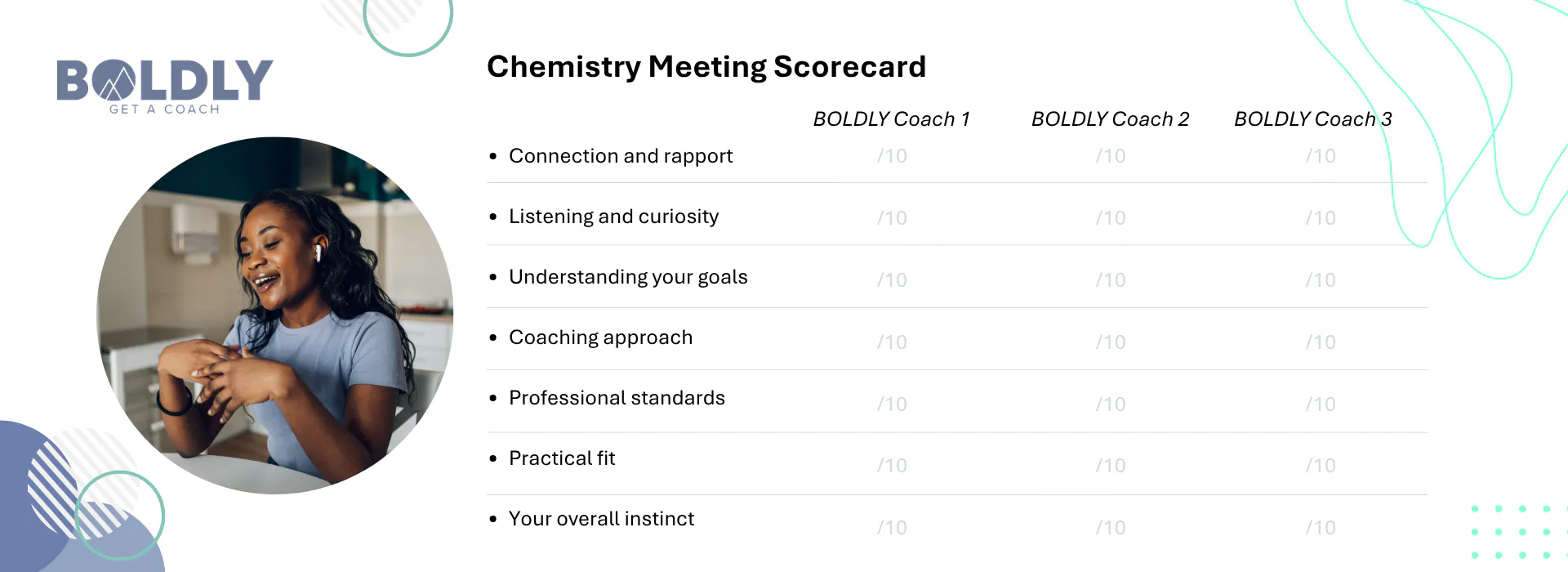
Chemistry Meeting Evaluation Scorecard
After completing a chemistry meeting, it can be helpful to step back and reflect on the conversation before making a decision. The following checklist can help you evaluate whether the coach is likely to be a strong partner in your development journey.
You do not need every item to be perfect, but the overall pattern of responses should give you confidence in the potential coaching relationship. You might find it helpful to rate each coach “out of 10” on each of the following areas. We recommend you do this immediately following your meeting when your impressions are fresh.
Your scorecard may include:
Connection and rapport
· Did the conversation feel natural and constructive?
· Did the coach create an environment where you felt comfortable discussing your goals and challenges?
Listening and curiosity
· Did the coach listen carefully and ask thoughtful questions?
· Did they demonstrate genuine curiosity about your context rather than quickly offering solutions?
Understanding your goals
· Did the coach show a clear understanding of your career or leadership challenges?
· Were they able to reflect back what they heard in a way that felt accurate and insightful?
Coaching approach
· Did the coach explain how they typically structure coaching engagements?
· Were they able to describe the methodologies or frameworks they draw upon?
Professional standards
· Did the coach demonstrate professional credibility through their experience, qualifications, or coaching background?
· Did they clearly explain confidentiality and ethical boundaries?
Practical fit
· Does the coach’s availability and preferred coaching format suit your schedule?
· Are you comfortable with the proposed structure and cadence of the coaching sessions?
Your overall instinct
· Do you feel motivated to work with this coach?
· Can you imagine having open and honest conversations with them over several months?
If most of your answers are positive, the coach is likely to be a strong candidate for your coaching engagement.
How to Use This Scorecard
If you are meeting multiple coaches, consider completing this checklist immediately after each chemistry meeting. Writing down your reflections while the conversation is still fresh can make it much easier to compare your experiences later.
Many professionals find that reviewing their notes across several meetings quickly reveals which coach felt like the strongest fit.
Common Misconceptions About Chemistry Meetings
Because chemistry meetings are typically offered at no cost, some people assume they are an opportunity to receive a free coaching session. In reality, the purpose of the conversation is to explore whether a coaching relationship would be effective, rather than to begin solving specific challenges.
Another common misconception is that the coach should immediately provide answers or advice. Coaching is designed to support reflection and insight rather than deliver direct solutions. During a chemistry meeting, coaches are more likely to ask questions that help them understand your goals and context.
It is also important to remember that rapport alone does not determine whether a coaching relationship will be successful. While personal comfort is important, factors such as coaching experience, methodology, and professional standards are equally significant in determining whether the engagement will support meaningful development.
Chemistry Meetings in Organisational Coaching Programs
In many organisations, chemistry meetings are part of a structured process used to match leaders with appropriate coaches. Companies investing in executive coaching often provide leaders with profiles of several coaches and invite them to meet two or three before making a selection.
This approach allows leaders to compare different coaching styles and perspectives before committing to an engagement. It also ensures that the leader feels a sense of ownership in the selection process, which can strengthen engagement with the coaching journey.
From an organisational perspective, chemistry meetings help ensure that coaching investments support leadership development goals effectively. By facilitating a thoughtful matching process, organisations increase the likelihood that coaching engagements deliver meaningful outcomes for both the individual leader and the wider organisation.
When a Chemistry Meeting Is Not the Right Fit
Occasionally, a chemistry meeting may reveal that coaching is not the most appropriate form of support at that moment. Coaching requires a willingness to reflect, experiment with new approaches, and take responsibility for personal development. If someone is primarily seeking advice, mentoring, or a specific technical solution, another form of professional support may be more suitable.
Similarly, coaching works best when there is a genuine commitment to the process. Leaders who are extremely time constrained or who feel pressured into coaching may find it difficult to engage fully in the reflective work required.
Recognising these situations early is valuable for both parties. A thoughtful chemistry meeting helps ensure that coaching begins only when there is genuine alignment around goals, expectations, and readiness for the development journey.
Remember, the goal is to find a coach who not only has the right qualifications but also someone with whom you can build a strong, productive working relationship. Don't hesitate to have up to 3 Chemistry Meetings before making a decision, as the right fit is crucial for successful coaching outcomes.
Arranging a Chemistry Meeting does not mean you’re obliged to engage the coach, and there is no charge for this call. Click here to find out more.

If you're interested in learning more about how BOLDLY can help your organisation, we invite you to explore our or write to us at connect@boldly.app.
Looking for more resources?
How to ask your boss for a coach
What type of goals should you have?
AUTHOR: Maggie
Maggie Wong is a Coach Business Partner at BOLDLY, where she helps bring world-class coaching to organizations around the globe. She supports the onboarding and development of new coaches while connecting clients with exceptional coaching talent tailored to their needs. Maggie works closely with leaders and organizations on initiatives related to top team effectiveness, leadership development, and large-scale coaching programs. Passionate about enabling meaningful growth, she focuses on building strong partnerships that help individuals, teams, and organizations thrive.